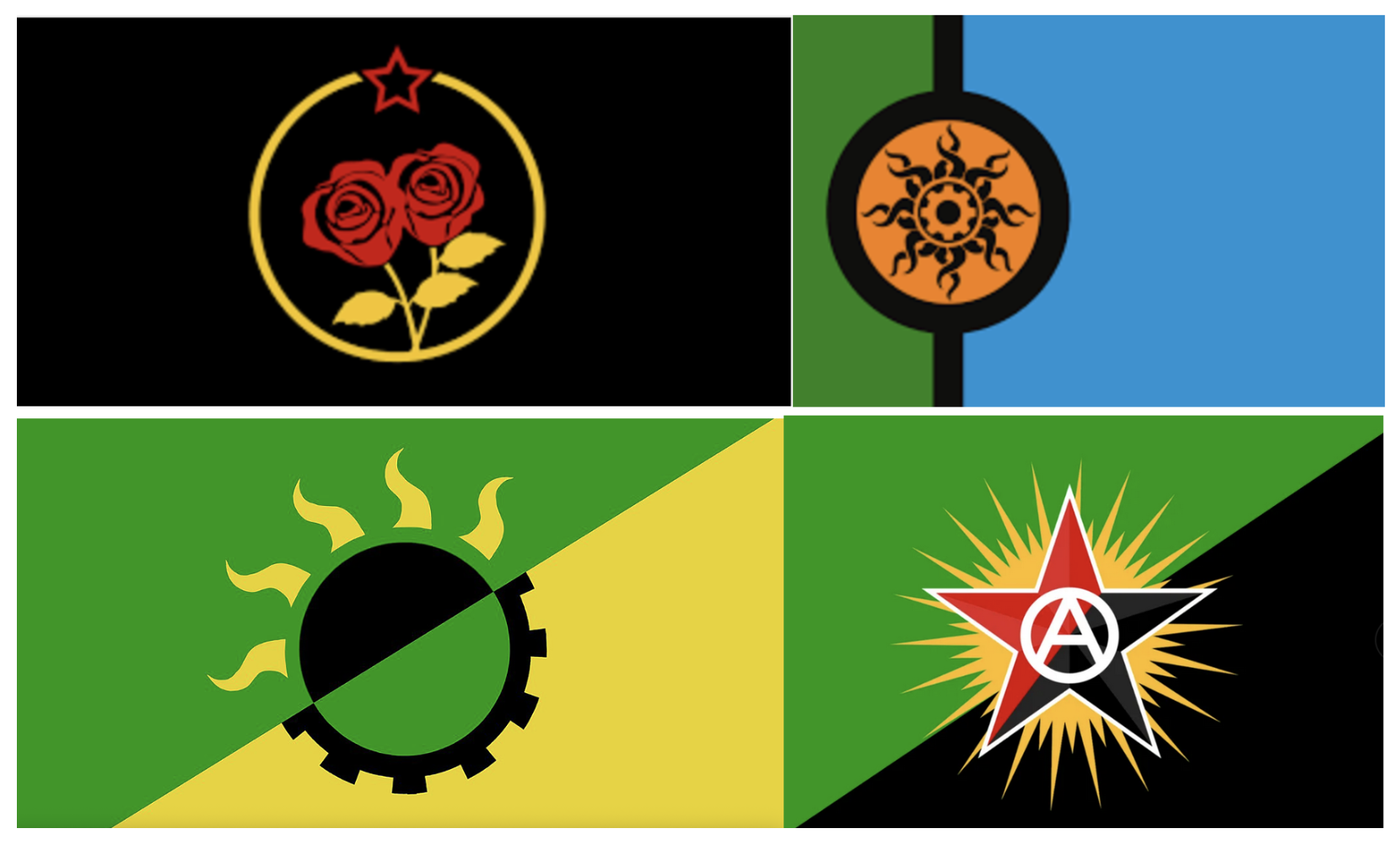
Utopian Proposal for the SF East Bay Bioregion
A proposal for ecological restoration and social equality — organized through local watersheds
In The Ohlone Way the East Bay Bioregion - before the arrival of colonialism and capitalism - is described as a landscape of remarkable abundance: salmon-bearing streams, vast wetlands, oak woodlands, grasslands, and thriving human communities. The East Bay once demonstrated that human communities can exist within a thriving ecological system. Remembering this inspires us to build a new egalitarian future.
Today, the SF East Bay contains enormous inequality. Life expectancy varies by up to 25 years due to crippling injustice. Non-human species are stripped of habitat and threatened with extinction. Two hundred years ago indigenous villages in this area treated land, water, and food as common property, but today, basic human necessities are only available if you can pay the accelerating price. Laws that govern our communities are often formulated by distant bureaucracies, and non-human animals are defenseless in their ravaged homeland. Green democracy can thrive here, in the SF East Bay Bioregion. We believe political communities need to be structured inside ecological geography. This essay proposes the creation of a federation of watershed democracies organized around direct participation, economic equality, and ecological restoration.
Ecological Goals
Watersheds are geographical systems that deliver networks of life. The East Bay Bioregion is a federation of watersheds linked by shared ecology. We want our human communities to exist in collaboration with this environment. The health of the watershed will be a major measure of our social success. To accomplish this, we aim for the following:
Restore Every Creek and Stream - East Bay creeks are buried in culverts, channelized in concrete, diverted underground, or treated as storm drains. We seek to daylight Temescal Creek, Sausal Creek, Glen Echo Creek, Alameda Creek, San Leandro Creek, Codornices Creek, and Cerrito Creek. We want our local waterways to be ecological corridors and wildlife pathways.
Reforestation - we will plant millions of trees, prioritizing Coast Live Oak, Valley Oak, California Black Oak, Redwood, Bay Laurel, Buckeye, Alder, California Sycamore, Willow, and Cottonwood. This will reduce urban heat, increase biodiversity, stabilize hillsides, capture carbon, and improve air quality. We want urban forest and food forests. Every school should have an orchard, every park needs an edible landscape, every major street needs to be shaded by native trees, and we need extensive pollinator corridors. Oakland will enjoy massive native oak restoration.
Rewild Habitat Corridors - Wildlife will move safely across our landscapes. Deer, coyote, raccoon, river otter, skunk, beaver, fox, bobcat, mountain lion, owl, hawk, and turkey will roam freely throughout our watershed as we connect shoreline habitat to creek greenway corridors, and hill ecosystems.
Restoration of Shoreline - For over a century the Bay has been filled, industrialized, armored with concrete. Our goal is to restore wetlands, marshes, shorelines, and habitat for fish and migratory birds. Salmon runs can return here if we daylight streams, remove barriers, improve water quality, and restore spawning habitat.
Greenway Network - People will be able to walk or cycle throughout our East Bay bioregion via creek corridors, food forests, parks, and restored habitats.
Replace Lawns with Living Landscapes - Lawns consume water, fertilizer, and labor without producing food or habitat. We will replace lawns with food-producing landscapes, native gardens, orchards, and pollinator habitat.
In our East Bay Bioregion every creek will run clean, every neighborhood will be shaded by trees, every resident will have access to fresh food, and wildlife will be able to move freely from hills to the shoreline - even salmon and steelhead trout will once again migrate through East Bay waters! In our bioregion, human flourishing and ecological flourishing will be seen as identical goals.
Food Sovereignty
Our bioregion will produce its own food. We will encourage community farms, rooftop gardens, edible streetscapes, food forests, neighborhood orchards, and cooperative greenhouses. Our cities will have gardens, farms and orchards everywhere and all residents will live within walking distance of food production. Vacant lots, lawns, school grounds, rooftops, and public land will become productive landscapes. We imagine the whole chain made visible and democratically accountable: urban gardens flow into community farms, community farms into regional farms, regional farms into food cooperatives, and food cooperatives into neighborhood kitchens and markets. This is not a demand for total self-sufficiency - it is a demand that our relationship with the land that feeds us be seen and governed by the people who depend on it, rather than hidden inside a distant supply chain.
Solar for All
Our bioregion enjoys abundant sunlight. Utilizing this, we aim to establish rooftop solar on residential and commercial roofs, plus solar canopies over parking lots. We will also establish neighborhood micro-grids, neighborhood battery storage and community owned energy cooperatives, and electrified transit. We hope to reduce automobile traffic by 90 percent and to completely eliminate fossil fuel dependence.
Green Architecture
We will encourage green roofs and green walls with native and/or edible plants. Many streets and plazas will be pedestrian-only. Underground buildings and urban skyscrapers will liberate the topsoil for wild areas and agriculture. Rainwater harvesting and greywater systems will be installed.
True Democracy
We need to end hierarchy in all its forms — economic, political, social, cultural. Our governance rests on one guiding principle: subsidiarity. Decisions should be made at the smallest level capable of making them well. A neighborhood decides how to run its community garden. A handful of neighborhoods coordinate a shared food-distribution system. A ward coordinates public transit. The whole bioregion coordinates the watershed. No issue is delegated upward unless it truly requires a wider scale of cooperation.
Neighborhood Assemblies
At the smallest local level we want Neighborhood Assemblies of 5,000 to 10,000 people, who enjoy direct decision-making. There are no “representatives” - the people directly decide for themselves, determining housing policies, local infrastructure, community life, and ecological care. No issue is delegated upwards unless it is absolutely necessary. Each assembly organizes standing committees so its work is not left to whoever happens to be in the room that night: committees for housing, food, transportation, public safety, parks and ecological restoration, childcare, education, energy, disability access, and emergency preparedness. Committees prepare proposals and do the research; the assembly itself decides.
Ward Councils
Above the Neighborhood Assemblies are the Ward Councils, representing approximately 100,000 people (10-20 confederated assemblies). This political body is responsible for education systems, transportation, and infrastructure shared between the neighborhood districts. Delegates from the Neighborhood Assemblies are sent to the Ward Councils - they are not rogue free agents; they are the messengers of decisions made in Neighborhood Assemblies. The delegates are strictly bound to carry out the decisions of their communities; delegates are recallable, and rotated quickly. The delegates do not speak for themselves; they transmit exactly what their Neighborhood Assembly has already decided.
Watershed and Creek Councils
Running alongside this political ladder is an ecological one. Every creek and watershed in the bioregion is represented by its own Watershed Council, made up of delegates sent from each Neighborhood Assembly whose land drains into it. A neighborhood may sit inside one ward for questions of schools and transit, and inside a different watershed council for questions of water, wildlife corridors, and creek restoration. Political geography and ecological geography are allowed to overlap rather than being forced into a single grid, because a watershed does not care about ward boundaries. Watershed Councils federate upward into regional watershed congresses that coordinate large-scale ecological issues across the bioregion.
The Bioregional Council
Above the Ward Council confederations is the Bioregional Council, representing 7-10 Ward Councils (700,000 - 1,000,000 people). This council coordinates the decisions of the lower government bodies, and reaches decisions that impact the entire SF East Bay Bioregion: watershed management, shoreline restoration, regional energy infrastructure, and climate adaptation.
From City Hall to Coordinating Body
Existing city governments - Oakland, Berkeley, Richmond, San Leandro, and their neighbors - do not disappear overnight, but their role changes. City Hall stops being the primary center of political power and becomes an administrative and coordinating body accountable to the confederation of assemblies. Elected representatives are replaced, or supplemented, by recallable delegates sent from Neighborhood Assemblies. This is the difference between representative democracy - “vote for someone to make decisions for us” - and confederal democracy - “we make decisions ourselves, and send delegates to coordinate what we cannot decide alone.”
Real Power for Everyone
Formal democracy is not the same as substantive democracy. Simply allowing everyone to vote does not mean everyone has equal political power. If assemblies were organized around property ownership, or ran on the same informal habits that let the loudest and most privileged voices dominate a room, wealthy neighborhoods and practiced activists would capture power just as they do now. Our assemblies will build in deliberate mechanisms so that renters, unhoused residents, youth, immigrants, disabled people, low-income residents, and people with limited English proficiency hold real and meaningful power, not just a formal vote. Interpretation, accessible meeting times and locations, childcare during assemblies, and outreach beyond the people who already show up are basic infrastructure of democracy, not optional extras.
Resolving Conflicts Between Local and Regional Decisions
Subsidiarity does not eliminate conflict; it relocates it. A Neighborhood Assembly may resist new housing in its area; the Bioregional Council may determine that the whole region needs more housing to end the crisis of displacement and homelessness. Confederalism needs an honest way to work through this kind of conflict rather than pretending it away: mediated dialogue between the assembly and the council, a clear and public airing of the region-wide need, appeal processes, and ultimately confederation-wide votes when consensus cannot be reached. Local autonomy is real, but it is not absolute; it exists inside a wider circle of mutual responsibility.
Creating the Commons
Land reform is needed in the SF East Bay Bioregion. We seek a transition from private ownership of land toward a system of shared Common Land. We want land in our bioregion to NOT be owned in the way that capital owns commodities. Our Common Land will be shared, and extraction of resources from our bioregion will be replaced by stewardship. Factories and workplaces will also become common property, controlled by worker cooperatives. All production will be reorganized around social public need / community welfare - rather than individual capitalist profit.
There will be no landlord class, no rentier class, no vast accumulations of wealth, and no poverty. Our new economy will be organized to provide everything for everyone, “from each according to their ability, to each according to their needs.”
Gift Economy Transition
Our eventual goal is to move from exchange to “gifting.” From currency costs to free access, from greedy competitive acquisition to free circulation. The Gift Economy we want is not barter, or vouchers, or hidden accounting. It is social life organized around generosity, reciprocity, and mutual aid. People giving and receiving based on need, capacity, and solidarity. We want a moneyless society, replaced by relationships and care.
Upcycling
We will establish neighborhood workshops that encourage the repairing and re-fabrication of commodities. This will hugely reduce landfill and teach people the valuable, creative skills of sewing, carpentry, and bicycle and electronics repair.
Public Safety and Community Self-Governance
What does safety mean once policing is no longer the default answer? We ask who should be responsible for keeping a community safe, rather than assuming the answer must always be armed strangers dispatched from outside the neighborhood. Our bioregion will build community crisis-response teams, mental-health responders, violence-interruption programs, restorative-justice circles, youth programs, and neighborhood mediation as the first response to conflict and harm.
We do not pretend this is simple. What happens when someone presents an immediate danger to others? Who holds coercive authority, and how is it kept accountable to the community rather than to a distant chain of command? We do not have a tidy answer to every hard case, and we distrust anyone who claims they do. What we commit to is this: any authority to use force must be small, local, transparent, and directly accountable to the Neighborhood Assembly it serves, never independent of it.
Justice
Punishment is not rehabilitation. Today's prisons rarely repair the harms they claim to address. In our new society we will not outsource conflict to violent, private institutions. Instead, we will address harm directly, offering mediation instead of coercion. Our goal of justice will not emphasize punishment. Instead, we will promote restoration, accountability, and reintegration into community life.
Gender and Political Power
Political power is not only won at the ballot or in the assembly hall; it is shaped by who does the childcare, who does the domestic labor, and who is free to show up in the first place. We take seriously the tradition - found in Kurdish democratic confederalism and elsewhere - that treats women's autonomous organizing as a foundation of democracy, not an afterthought to it. Every Neighborhood Assembly will support an independent women's and marginalized-gender council, with real standing to initiate proposals and to weigh in on decisions that bear directly on gender equity. This extends into childcare cooperatives, shared elder care, reproductive autonomy, workplace democracy, and firm community protection against gender-based violence. A society that calls itself democratic while leaving this work invisible and unequal has not yet become democratic.
The Problems
We do not present this as a utopia without flaws, and we distrust any vision that claims to be. Local democracy can curdle into NIMBYism, where a well-organized neighborhood uses the language of self-governance to exclude the people who need housing or services most. Assemblies can be quietly dominated by whoever has the most free time, the most confidence in public speaking, or the most political experience, while working parents, shift workers, and the exhausted stay home. Consensus can wear people down, and some decisions genuinely need to be made quickly. Confederations, like any coordinating body, can slowly accumulate power and calcify into a bureaucracy no different from the ones we set out to replace. And ecological restoration does not automatically produce justice - a plan that is wonderful for the watershed can still displace the poorest residents if we are not deliberately watching for that.
None of this is a reason to abandon the project. It is a reason to build in recall, rotation, transparency, and honest self-examination from the very beginning, rather than assuming good intentions will be enough.
Our Political Strategy
Our ideas can steadily infiltrate and replace the present destructive system. Authoritarian power can shift to horizontally-led institutions. Representative democracy can be replaced by direct participatory institutions. Hierarchies can be dismantled. City Hall itself can be transformed, ward by ward, from a seat of authority into a coordinating servant of the neighborhood assemblies. The transformation will occur through democratic participation, cooperative development, and the gradual expansion of commons-based institutions.
Summary
In the SF East Bay bioregion that emerges: Wildlife corridors link Tilden, Redwood Park, and San Francisco Bay. Lake Merritt is fed by visible streams rather than buried culverts. No one is homeless. No one is a billionaire. Neighborhood assemblies meet beneath restored oak groves, their watershed councils tending the creeks, their women's councils holding real power at the table. Governance is coordination among equals and economy is sharing the local abundance. Hierarchy is replaced by egalitarian relations among equals. People live in a beautiful, restored landscape, sharing the region with thriving forests, clean waterways, returning wildlife, and one another.
References
Peter Kropotkin — commons, mutual aid, gift economy
Élisée Reclus — anarchism, geography
Murray Bookchin — assemblies, confederation, social ecology
Abdullah Öcalan — democratic confederalism, women's liberation
Janet Biehl — libertarian municipalism in practice
Starhawk — urban greening
Ernest Callenbach — upcycling, transit
Rojava — democratic confederalism in practice
Kerala — decentralized governance
Solarpunk — ecological restoration, renewable energy, food sovereignty
Bioregionalism — watersheds as political geography
Practical Steps for Transition
Democracy
Determine map-lines for neighborhood assemblies - they will be primary governing bodies.
Organize neighborhood assembly monthly meetings
Develop community constitutions
Train facilitators and mediators.
Create youth councils and elder councils.
Create independent women's and marginalized-gender councils within each assembly.
Publish neighborhood websites and create neighborhood newsletters.
Encourage participatory budgeting.
Federate neighborhood assemblies into wards.
Assemblies send recallable delegates to ward council meetings.
Ward council meetings coordinate services between neighborhood assemblies.
Establish watershed councils to manage ecological systems.
Hold watershed congresses to coordinate large-scale issues.
Establish a mediation and appeal process for conflicts between assemblies and the confederation.
Begin transferring City Hall functions to confederation-accountable administration.
Public Safety & Justice
Train community crisis-response and mental-health response teams.
Launch violence-interruption programs.
Establish neighborhood mediation and restorative-justice circles.
Create youth diversion programs.
Build local accountability structures for any coercive authority.
Reduce and ultimately end reliance on punitive incarceration.
Mutual Aid
Circulate the resource guide Everything Free in the SF East Bay
Create mutual aid networks
Create emergency support teams - street medics.
Create free food programs
Set up community fridges
Establish free stores
Launch time banks (if we're doing reciprocal ‘mutualism’)
Create skill-sharing networks
Set up repair clinics
Establish tool libraries.
Food Sovereignty
Develop multiple neighborhood farmers markets.
Support urban farms & gardening classes
Convert lawns to habitat.
Establish food cooperatives.
Build cooperative kitchens.
Plant community gardens
Plant public orchards & Food Forests
Plant edible schoolyards.
Establish seed banks and libraries
Set up greenhouse cooperatives.
Organize composting projects
Schedule gardening classes.
Ecology
Map all local watersheds
Map buried creeks.
Organize creek cleanups
Daylight creeks.
Remove invasive species.
Plant native trees
Plant pollinator gardens.
Install owl boxes.
Create biodiversity surveys.
Restore riparian corridors.
Restore wetlands.
Restore shoreline habitat.
Reconnect wildlife corridors.
Expand oak woodlands.
Expand redwood groves.
Restore steelhead habitat.
Restore salmon habitat.
Reintroduce beavers
Wildlife corridors connect hills and shoreline.
Economy
Launch worker cooperatives
Set up childcare cooperatives
Establish elder cooperatives.
Set up credit unions
Land is common stewardship.
Housing is a social guarantee.
Utilities are community-owned.
Necessities are universally available.
Production is organized around need.
Gift institutions are normal.
Libraries of things are universal.
Knowledge is freely shared.
Convert vacant buildings into housing
Develop eco-villages.
Establish housing commons.
Cooperation and social provision is the accepted culture.
Energy
Create solar cooperatives.
Build neighborhood microgrids.
Install community batteries.
Electrify public buildings.
Electrify transit.
End fossil fuel consumption.
Solarpunk Future
All energy is renewable.
Cities are shaded by trees.
Greenways connect communities.
Most daily trips are walking, cycling, or transit.
Buildings generate energy.
Waste is minimized.
Ecological literacy is universal.
The health of the watershed is a primary measure of success.
Human flourishing and ecological flourishing are mutually reinforcing.